Small Living Room Organization Ideas for Renters: 7 No-Drill Ways to Save Space and Your Deposit
A small living room in a rental fails in a predictable way. Every surface collects clutter, the sofa eats the floor plan, and every storage idea online seems to start with a drill your lease forbids. These small living room organization ideas work the other way: nothing screwed into walls, nothing anchored, nothing your landlord can charge you for at move-out. Seven ideas, one deposit-safe system.
The No-Drill Rule: What Counts as Deposit-Safe
Before buying anything, apply one test. If it needs a drill, a wall anchor, or a permanent adhesive, skip it. Deposit-safe storage is freestanding, tension-mounted, over-door, or removable adhesive used exactly as the product instructs.
This is also where most rival guides go wrong for renters. Floating shelves and wall-mounted TVs look tidy in photos, but both need anchors in your wall. A renter who copies them trades a tidy living room for a repair bill. Every idea below passes the no-drill test, and each one notes its deposit risk honestly: none, or low with one condition you must respect.
1. One Large Rug Plus Leggy Furniture
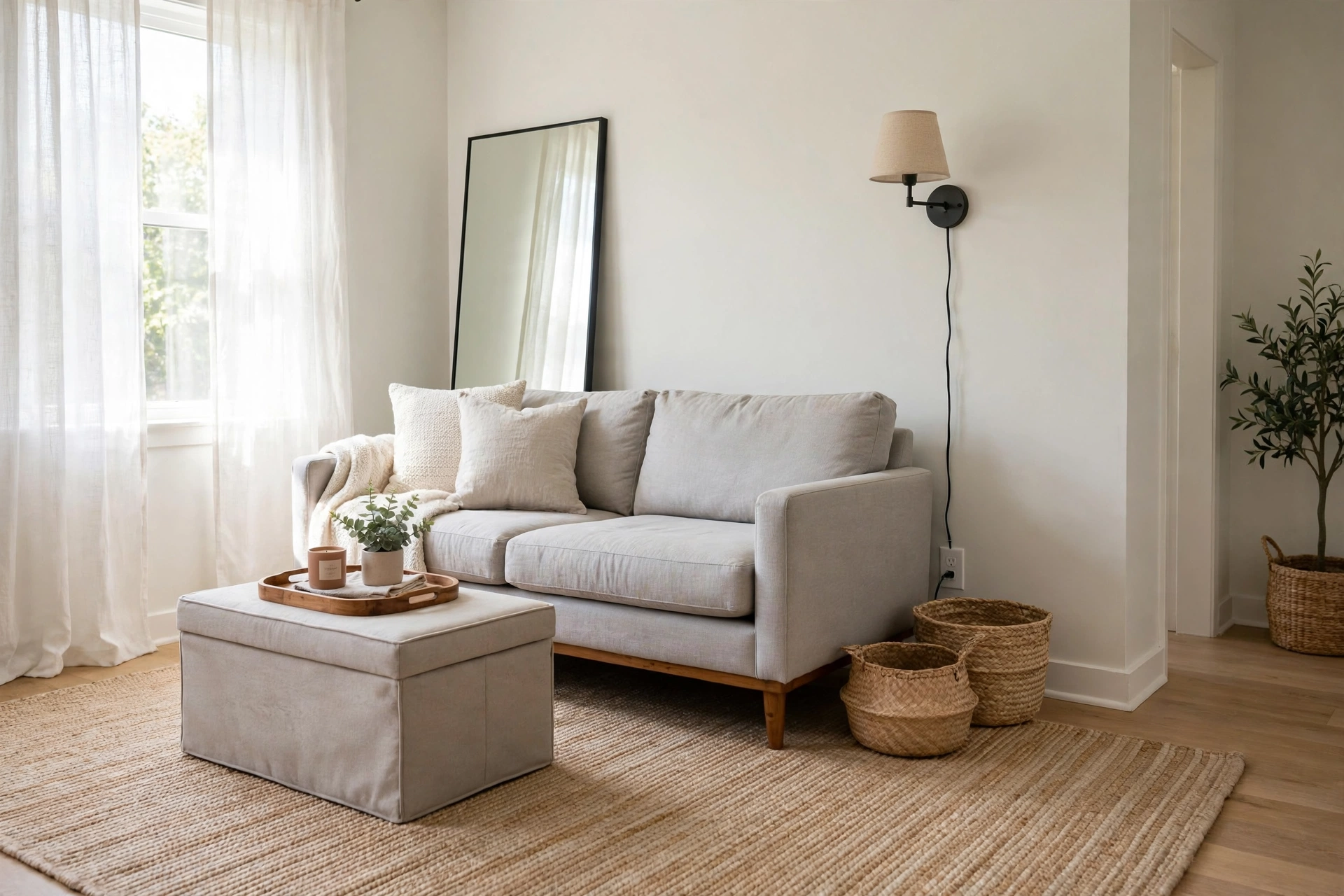
Start with the floor, not with storage. One large rug with the front legs of the sofa and chairs on it makes the seating area read as one intentional zone instead of scattered furniture. Then favor leggy furniture, meaning sofas and chairs with raised, visible legs. When you can see floor under furniture, the room looks bigger without adding a single item.
Deposit risk: none. A rug and furniture choice change nothing permanent. Time: an afternoon of rearranging what you already own, before you spend anything.
2. A Slim Behind-Sofa Console or C-Table
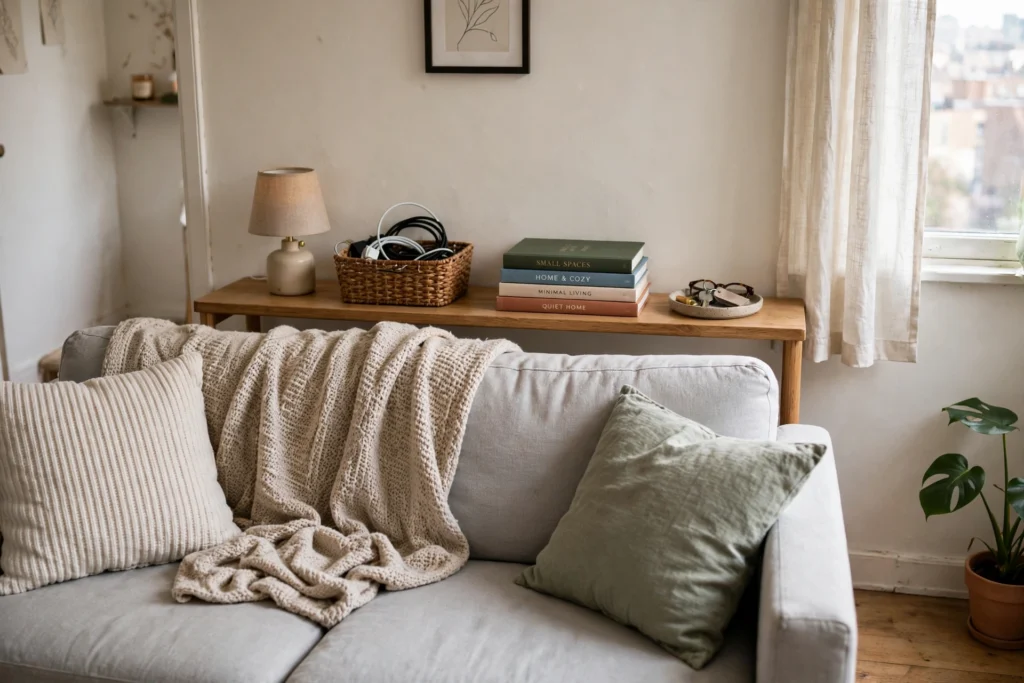
The strip of floor behind a sofa is usually dead space. A slim console table, or a C-table that slides its base under the sofa, turns it into a surface for lamps, chargers, and books. It also stops the gap behind the sofa from becoming a graveyard for lost remotes and cables.
Pick a console no deeper than the gap you actually have, and measure first. A console that blocks a walkway or a radiator is worse than no console. Deposit risk: none. It stands on the floor and moves with you.
3. A Storage Ottoman and Nesting Tables
A coffee table holds a few magazines at best. A storage ottoman holds blankets, board games, chargers, and remotes, and it still works as a footrest and as extra seating when friends come over. Add a flat tray on top and it becomes a coffee table too. That is four jobs from one piece, with zero wall contact.
Nesting tables are the quieter version of the same idea. Three surfaces when you are hosting, one small footprint when you are not. Pull one out for a guest, tuck it back when they leave.
Deposit risk: none. Both pieces are freestanding. Time: minutes to place, and the ottoman pays off the first evening you use it.
4. A Leaning Mirror and Plug-In Sconces
Light is storage’s silent partner: a brighter room looks tidier even before you organize it. A leaning mirror, propped against the wall opposite a window, bounces daylight across the room and needs no fixing at all. For evenings, plug-in sconces give you wall-light looks with a cord and a plug, not a drill. Choose sconces with a cord cover if the cord would otherwise dangle visibly.
One safety note: a leaning mirror must sit on a stable floor and lean at a slight angle, never balanced upright. In a home with small children or large dogs, anchor the question to safety first and skip the leaning mirror if it could tip. Deposit risk: none for the mirror and sconces themselves. Time: under half an hour.
5. Under-Sofa Baskets and Over-Door Pockets
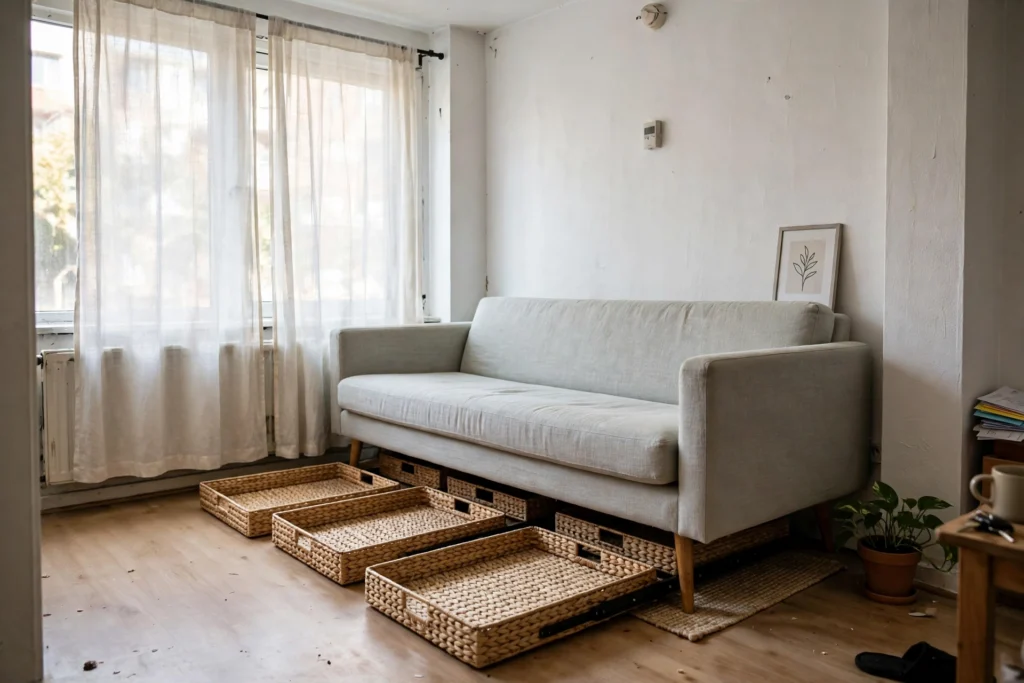
The space under a sofa with visible legs is a shallow drawer you already own. Flat baskets there hold throws, chargers, and the board games that otherwise colonize the coffee table. Woven baskets also soften a room that hard furniture makes feel boxy.
For the small things, use the back of a door. An over-door pocket organizer on the living room or hall door holds remotes, chargers, and cables in labeled pockets, using the same no-drill logic as our over-the-door organizer guide. Pad the brackets with felt so the door edge stays scuff-free, and keep each pocket light so the door still latches.
Deposit risk: none for baskets. Low for over-door pockets, conditional on padded brackets and light loads.
6. Curtains Hung High and Wide on a Tension Rod
Curtains hung just above the window frame and wider than the window make the window look larger, which makes the whole room feel larger. In a rental where drilling a curtain rod is banned, a tension rod inside the window recess does the job with zero holes. It also comes down in seconds at move-out.
Measure the recess before buying, and test the rod’s grip with a firm tug before hanging heavy curtains. Sheer or light cotton panels are the safe choice on a tension rod; heavy blackout drapes belong on a proper rod only if your lease allows it. Deposit risk: none with light curtains. Time: ten minutes.
7. The One-In-One-Out Edit and a Move-Out Checklist
Organization systems die from accumulation, not from bad baskets. Adopt one rule: when something new enters the living room, something old leaves it, donated, sold, or stored elsewhere. The same rule keeps our small bedroom closet guide working, and it works here for the same reason: a small room has a fixed volume.
Then protect the deposit on your way out. Photograph the room on move-in day and again on move-out day. Remove tension rods and check for rubber marks (rubbing alcohol clears them). Peel adhesive strips slowly, following the product’s removal instructions, and use heat if the product recommends it. Take the leaning mirror and sconces with you. Nothing you installed in this guide needs patching, because nothing was ever fixed to the wall.
Deposit risk: none, provided you do the removal steps instead of rushing them.
What NOT to Do in a Rental Living Room
Skip these, however tidy they look online:
- Floating shelves mounted with anchors. They need holes, and filled holes still show on inspection.
- A wall-mounted TV. Same problem, heavier consequence.
- Adhesive shelves loaded past their weight rating, especially in humidity. They fail suddenly and take paint with them.
- Buying organizers before decluttering and measuring. Measure your zones first, then buy, or you will make a return trip to the store.
Your Weekend Plan
Do the ideas in this order and the room changes in one weekend:
- Saturday morning: declutter every surface, then place the rug and check which furniture legs are visible.
- Saturday afternoon: add the behind-sofa console, the storage ottoman, and the under-sofa baskets.
- Sunday: lean the mirror, plug in the sconces, hang the tension-rod curtains, and hang the over-door pockets.
- Sunday evening: run the one-in-one-out edit, photograph the finished room, and file the photos with your move-in pictures.
FAQ
Can I organize a small living room without drilling anything?
Yes. Every idea in this guide is freestanding, tension-mounted, over-door, or plug-in. Nothing here needs a drill, an anchor, or landlord permission beyond what your lease already allows for furniture.
Are adhesive hooks and strips safe for my deposit?
Only for light items, on smooth surfaces, within the product’s weight rating, and removed exactly as the product instructs. For the full renter rules on adhesive products, see our small bathroom storage ideas for renters, which apply the same logic in a harder room.
Does this no-drill formula work in other rooms?
It is the same system across the whole rental. Our under-sink bathroom guide works around pipes with bins and tension rods instead of screws, and our over-the-door organizer guide turns door backs into storage in every room.
How do I get my full deposit back?
Remove everything in reverse order, photograph the room as you found it, and keep your move-in photos. Since nothing in this guide is fixed to a wall, there is nothing to patch, only things to carry out.
Final Thoughts
A small rental living room does not need more square footage. It needs furniture that earns its place twice, light that makes the room feel larger, and a rule that stops clutter from creeping back. Start with the rug and the ottoman this weekend, add the console and baskets next, and let the one-in-one-out rule do the long-term work.
For the same no-drill logic in the messiest cabinet in the house, read our under-sink bathroom organization ideas. For the bathroom version of the renter rules, read our small bathroom storage ideas for renters.